
Repaired for Shalom
Jul 13
/
Grace Pouch
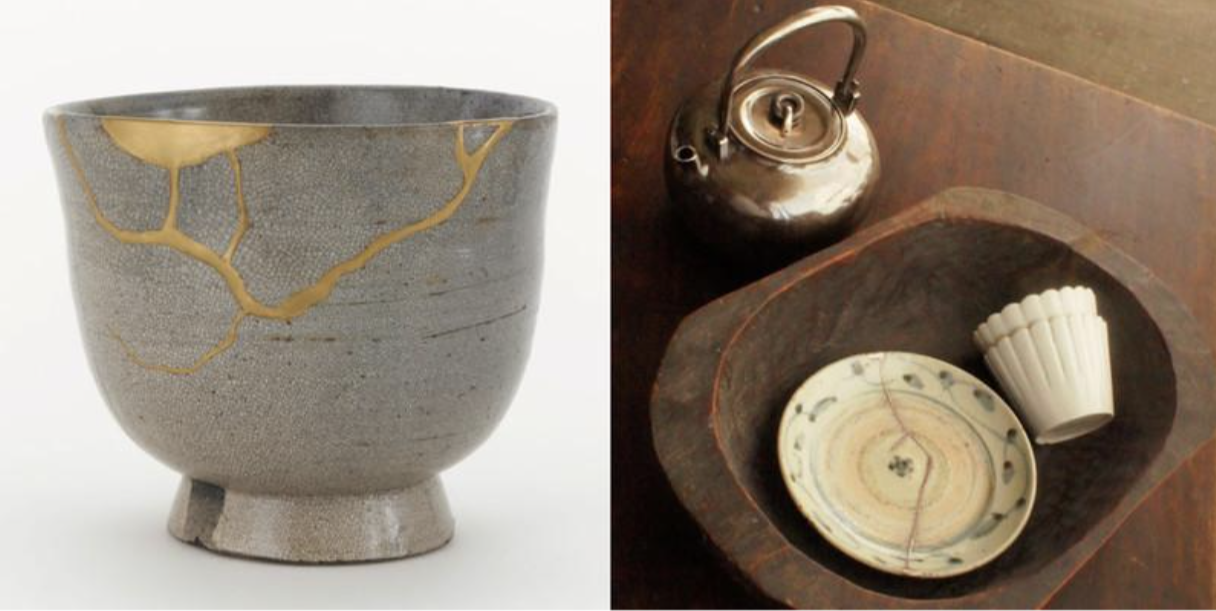
Most pictures of kintsugi are museum-like. A piece of pottery with lightning streaks of gold leaf sits on a sterile background. Displayed this way, as an artifact, we marvel at the artistry of a kintsugi vessel.
But I’m more drawn to the second image above. It shows a repaired plate, ordinary in appearance, back in circulation with the cups and tea kettle, set out for someone to use. Of course, cups, plates, and vases are mostly made to be useful. But when I see kintsugi displayed like sculpture apart from its original context, I forget that it had a function before it was broken. Now that it’s repaired, is it “just” art?
There’s nothing wrong with kintsugi-as-art. It’s beautiful. (My son and I are working on repairing a vase that fell victim to a raucous game of tag, and I plan to display it on a shelf.)
But I’m more drawn to the second image above. It shows a repaired plate, ordinary in appearance, back in circulation with the cups and tea kettle, set out for someone to use. Of course, cups, plates, and vases are mostly made to be useful. But when I see kintsugi displayed like sculpture apart from its original context, I forget that it had a function before it was broken. Now that it’s repaired, is it “just” art?
There’s nothing wrong with kintsugi-as-art. It’s beautiful. (My son and I are working on repairing a vase that fell victim to a raucous game of tag, and I plan to display it on a shelf.)
But as a symbol of repair in human lives, I prefer the down-to-earth image on the right. The plate is restored not just in form, but in function. Up on a pedestal isn’t where we belong. God mends us for something — for everyday practical use, in fact.
God is an Artist, to be sure. His ability to repair our deepest cracks and wounds is worthy of wonder. But as much as our mended lives testify to his skill, he has even more in mind for us than display.
By repairing individual lives, God is weaving an even greater shalom. Turning to another art form, the film The Mission illustrates the chain reaction of grace. In the story, a human trafficker named Roderigo Mendoza (Robert DeNiro) seeks to make amends for his life of greed and violence, so he joins a community of Jesuit missionaries in the Paraguayan jungle. Roderigo’s personal journey toward accepting God’s forgiveness unlocks his ability to grow into a person of love and reconciliation in this community.
The film dives headlong into broken systems and complex ethical questions — what to make of historical mission efforts that were entangled with national and economic ambitions, how to respond to the presence of both authentic and inauthentic leaders in the Church, and whether or not weaponized warfare is an acceptable means for achieving shalom. But at the heart of the story is the reality that when our deep flaws meet with God’s grace, the result is more than just individual holiness. Healed people become agents of healing.
Dallas Willard writes that God’s ultimate aim in human history is to take all his broken people and repair us for loving communion with himself and others.
Spiritual restoration isn’t about optics or even perfecting our quirks. It’s about healing the things that hold us back from love. God repairs us so that we can abide with him and reclaim our unique purpose in the world—God’s partners in setting things right in the world … co-artists in his “kintsugi kingdom,” as writer Katelyn Dixon calls it.
When we welcome the Spirit’s renewal, we are made into practical art of the highest quality, with no limit to the lowliness and breadth of its service at his table.
Quote
“My life is like a broken bowl.
A broken bowl that cannot hold
One drop of water for my soul
Or cordial in the searching cold;
Cast in the fire the perish’d thing;
Melt and remould it, till it be
A royal cup for Him, my King:
O Jesus, drink of me.”
– Christina Rossetti
From “A Better Resurrection”
Contemplate
God is an Artist, to be sure. His ability to repair our deepest cracks and wounds is worthy of wonder. But as much as our mended lives testify to his skill, he has even more in mind for us than display.
By repairing individual lives, God is weaving an even greater shalom. Turning to another art form, the film The Mission illustrates the chain reaction of grace. In the story, a human trafficker named Roderigo Mendoza (Robert DeNiro) seeks to make amends for his life of greed and violence, so he joins a community of Jesuit missionaries in the Paraguayan jungle. Roderigo’s personal journey toward accepting God’s forgiveness unlocks his ability to grow into a person of love and reconciliation in this community.
The film dives headlong into broken systems and complex ethical questions — what to make of historical mission efforts that were entangled with national and economic ambitions, how to respond to the presence of both authentic and inauthentic leaders in the Church, and whether or not weaponized warfare is an acceptable means for achieving shalom. But at the heart of the story is the reality that when our deep flaws meet with God’s grace, the result is more than just individual holiness. Healed people become agents of healing.
Dallas Willard writes that God’s ultimate aim in human history is to take all his broken people and repair us for loving communion with himself and others.
Spiritual restoration isn’t about optics or even perfecting our quirks. It’s about healing the things that hold us back from love. God repairs us so that we can abide with him and reclaim our unique purpose in the world—God’s partners in setting things right in the world … co-artists in his “kintsugi kingdom,” as writer Katelyn Dixon calls it.
When we welcome the Spirit’s renewal, we are made into practical art of the highest quality, with no limit to the lowliness and breadth of its service at his table.
Quote
“My life is like a broken bowl.
A broken bowl that cannot hold
One drop of water for my soul
Or cordial in the searching cold;
Cast in the fire the perish’d thing;
Melt and remould it, till it be
A royal cup for Him, my King:
O Jesus, drink of me.”
– Christina Rossetti
From “A Better Resurrection”
Contemplate
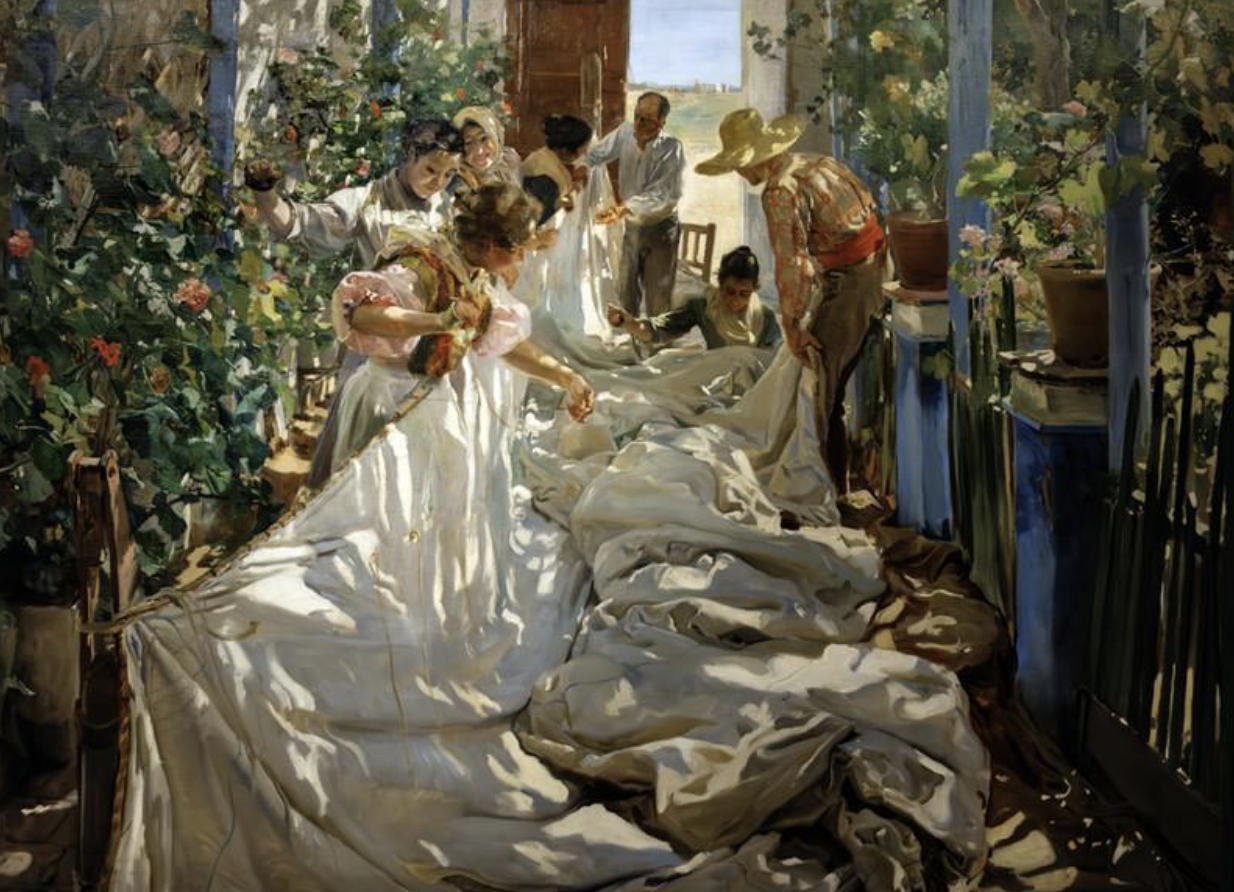
Mending the Sail
Joaquín Sorolla 1896 (source)
Mending is a process that permeates our lives (maybe less so these days, now that we’ve been trained to throw out and buy new). Think of some ways you participate in repair — taping a book cover, oiling the rusted latch, patching a tear in a shirt — or patching up a relationship, saying sorry, offering a handshake or a hug. Let these images grow in your mind as you lean into the invitation to be a person of reconciliation and repair.
Reflect and Pray
What is one crack in your character or one wound that holds you back from love?
What might be a practical next step toward welcoming God’s repair-work in your life?
Jesus, mend us with your artist’s eye and steady hand, and conform us to your pattern. Restore us to the joy of your way of life — a life of practical love and lowly service to one another. Amen.
Joaquín Sorolla 1896 (source)
Mending is a process that permeates our lives (maybe less so these days, now that we’ve been trained to throw out and buy new). Think of some ways you participate in repair — taping a book cover, oiling the rusted latch, patching a tear in a shirt — or patching up a relationship, saying sorry, offering a handshake or a hug. Let these images grow in your mind as you lean into the invitation to be a person of reconciliation and repair.
Reflect and Pray
What is one crack in your character or one wound that holds you back from love?
What might be a practical next step toward welcoming God’s repair-work in your life?
Jesus, mend us with your artist’s eye and steady hand, and conform us to your pattern. Restore us to the joy of your way of life — a life of practical love and lowly service to one another. Amen.

Grace Pouch
Grace Pate Pouch is Content Manager for Renovaré, where she curates and produces resources for spiritual renewal. She is the author of Savoring Childhood: Practical Wisdom for Slowing Down (IVP, 2026) and co-founder of the advocacy group Upstate Unplugged. She previously served as a seminary professor and Christian education specialist for elementary school children. Grace and her husband William live with their two children, Charlotte and Henry, in Greenville, SC.
You can find her at gracepouch.com, on Instagram @grace.pate.pouch, and on Substack @GrapplePie.
You can find her at gracepouch.com, on Instagram @grace.pate.pouch, and on Substack @GrapplePie.
Copyright © 2026
Tax ID: 92-0930963
Mailing Address
1205 E Oak Knoll Ct
Newberg, OR 97132
1205 E Oak Knoll Ct
Newberg, OR 97132
Resources
-
Join Our Newsletter
-
Donate
Social