
Daily Implications of Trinitarian Reality: A Practice for Advent and Christmastide
Dec 22
/
Jason Jensen
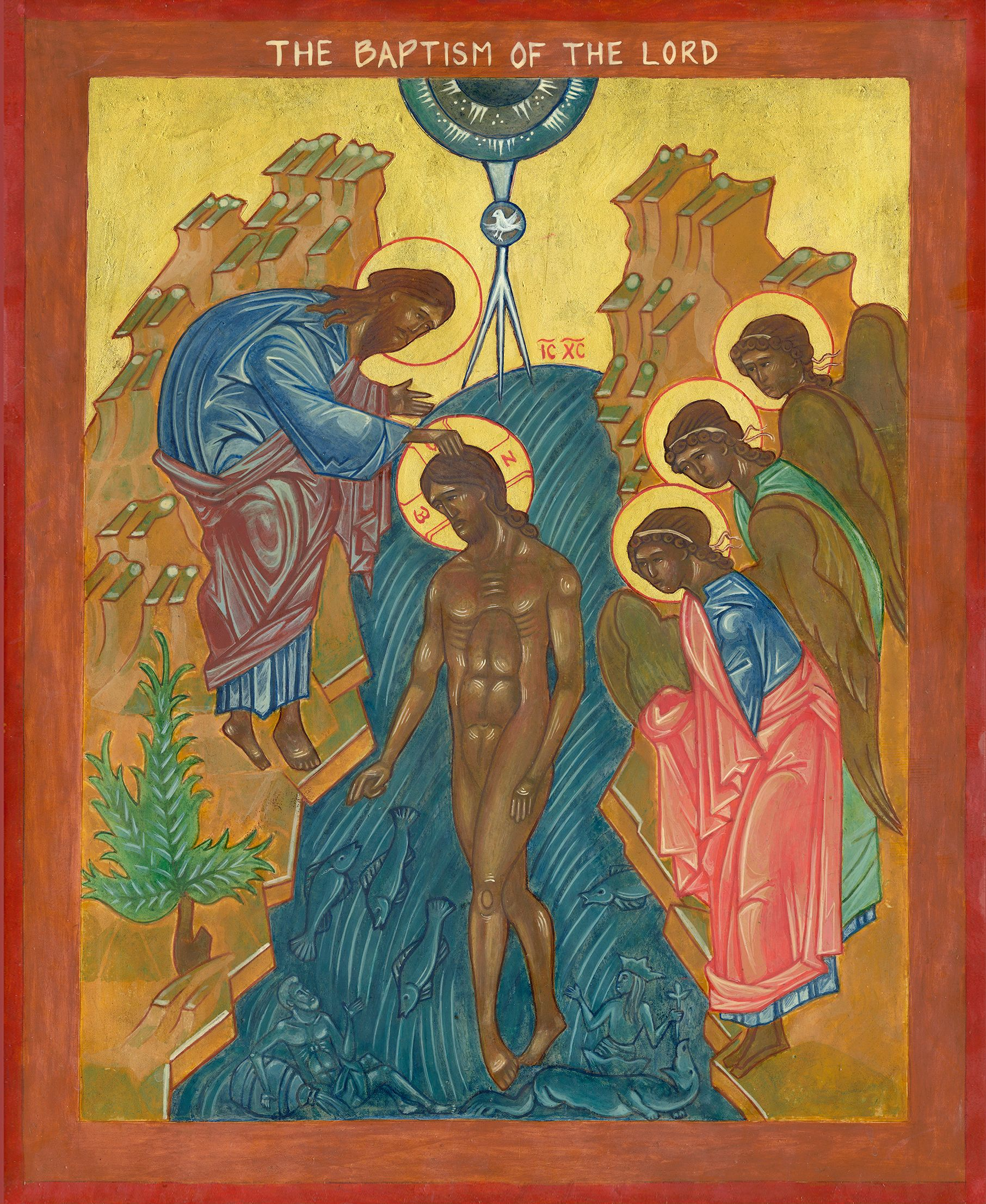
Icon by Sharon Henthorn-Iwane, see more at www.prayericons.com
Each morning, I spend a few quiet minutes gazing at an Eastern Orthodox Icon of the Baptism of Jesus, where Father, Son, and Holy Spirit are revealed together. While I’m visually absorbing the scene, I contemplate the Trinity and wait for the reality of God’s three-in-oneness to soak into my body and mind and soul. This may be a peculiar practice for a life-long American Protestant, but I do it because the practice changes me.
What difference does it make for us – daily and personally – that God is three in one? Of course, the church has agreed for millennia that the Trinity is central to our faith. But if we’re honest, many of us live as if Trinity is like the fine print that we don’t read in contracts. “It’s probably technical and important to someone, but I don’t really care.” Also, the Trinity usually seems… an abstract concept. Of course, the incarnation of Jesus is the perfect concrete expression of Trinity! However, few of us think or pray about the trinitarian dimension of incarnation, or the practical implications of that dimension. How can something so nebulous and intuitive make a concrete difference in my life?
A friend recently convinced me that time is an abstract concept, especially from the viewpoint of quantum physics. And yet, we pay practical attention to the implications of time every day. Temperature is also complex and abstract, and yet it influences our behaviors. We treat time and temperature as important practical considerations for good reasons. First, we trust that time and temperature actually exist, even if we don’t fully understand them. I don’t find many “time and temperature deniers” in my world these days. Second, we practice their implications. If we don’t prepare for the temperature, we feel the impact on our bodies. When we don’t recognize the passage of time, it often impacts us through other people in our lives.
So I’m asking myself, “How does the Trinity (which I understand very partially) impact my life practically?” Let me share some impacts I am beginning to recognize.
Because of the Trinity, my life is more relational, less transactional.
Temperamentally, I prefer a transactional life. I score 20 out of 20 toward “J” in the Myers-Briggs type analysis, meaning I really love closure and clarity. I take delight in crossing a task off my list. I was trained as an engineer, excellent at solving equations. Even in my early Christian training, my understanding of salvation was much more like a solved equation than a reconciled relationship. However, when I contemplate the Trinity, I recognize that the most fundamental reality in the universe, from before time into eternity, is the triune relationship of mutual love. Any transactions involved in creation, fall, redemption, faithful endurance, and consummation flow out of – and into – the more fundamental reality of Trinitarian Love. Because of this, day by day, I’m becoming less transactional and more relational about what I do. When facing work issues involving conflict, competing values, and contracts – I’m trying to ask how the transactions are impacting relationships, and how prioritizing relationships might change the transactions. This impacts what I choose and how I work. When facing questions of fairness, I’m more inclined to work on deepening trust than on balancing an equation. Again, the focus is different because of the primacy of relationship in how I view ultimate reality.
Because of the Trinity, I’m content with more mystery and less clarity.
Clarity and precision make me feel smart and secure. They fuel my confidence that I’m right – and perhaps even righteous! When I sit contemplating the Trinity, however, I tend to lose this illusion of security. Trinitarian reflection immerses me in waters I can’t navigate. I am unable to clearly understand both the three-ness and oneness of God. The mystery and paradox within the Trinity are larger and deeper than I am.
Yet strangely, when I enter the waters of trinitarian mystery, I’m embraced not by danger but by love. The complexity and simplicity of God are completely filled with mutual love. I find myself humbled, but not judged; corrected, but not shamed. At the baptism of Jesus, the Trinity is revealed together. The Spirit descends on Jesus in bodily form like a dove, marking him as the Christ, the anointed one. The Father’s voice says, “this is my son, the beloved, with whom I am well pleased.” That same trinitarian embrace enfolds me when I pray with the baptism icon. God’s overflowing threefold community pours over me with core identity, familial affection, and creative pleasure while I sit and receive. Over time, this trinitarian love has trickled in, charging my heart in a way that makes a daily difference.
When clarity invites me to pride or judgment, I am increasingly inclined to seek a degree of mystery. This counters some of the polarizing impulses in and around me. Even when I’m convinced of a clear position, our trinitarian God is helping me to hold that clarity humbly beneath the paradox of his gracious love.
I’m inclined to continue my peculiar practice of daily contemplating the Trinity icon. Little by little, it seems to be making me more joyfully human by enfolding me in relationship and mystery.
During this Advent and Christmastide, I invite you to join me in a trinitarian twist on praying about the incarnation. Saint Ignatius encourages this in the Spiritual Exercises. When reflecting on the miracle of the incarnation, Ignatius encourages us to imagine the conversation between Father, Son, and Holy Spirit, where they decide together to send Jesus into creation as a vulnerable baby. What does the Trinity discuss, and how do they feel? Dwell for a while on the conversation, and let the love, joy, and mystery soak into your soul.

Jason Jensen
Jason Jensen (MA, Fuller) is vice president of spiritual foundations for InterVarsity Christian Fellowship/USA. Jason led InterVarsity staff teams in Berkeley, California, for twenty-nine years. He and his wife, Susi, are based in Madison, Wisconsin, where Jason oversees the formation of InterVarsity staff in Scripture, theology, spiritual formation, and prayer. Their two adult children live in California. Jason’s book Formed to Lead: Humility, Character, Integrity, and Discernment traces themes of spiritual formation and leadership in the early chapters of Luke’s gospel. The book offers spiritual practices in each chapter, along with biblical and practical insights. Explore more at IVP.
Jason Jensen (MA, Fuller) is vice president of spiritual foundations for InterVarsity Christian Fellowship/USA. Jason led InterVarsity staff teams in Berkeley, California, for twenty-nine years. He and his wife, Susi, are based in Madison, Wisconsin, where Jason oversees the formation of InterVarsity staff in Scripture, theology, spiritual formation, and prayer. Their two adult children live in California. Jason’s book Formed to Lead: Humility, Character, Integrity, and Discernment traces themes of spiritual formation and leadership in the early chapters of Luke’s gospel. The book offers spiritual practices in each chapter, along with biblical and practical insights. Explore more at IVP.
Copyright © 2026
Tax ID: 92-0930963
Mailing Address
1205 E Oak Knoll Ct
Newberg, OR 97132
1205 E Oak Knoll Ct
Newberg, OR 97132
Resources
-
Join Our Newsletter
-
Donate
Social