
Feasting On Hope: How Embodied Practices Make the Gospel Tangible
Feb 2
/
Hannah Miller King
As a writer, I tend to live in my head. Sometimes my kids will be talking to me and I don’t hear them because I’m deep in mid-thought. Or I’ll be driving to the grocery store and make a wrong turn because I am distracted by an idea. But this tendency toward disembodied thought isn’t just a problem for certain personality types; it is also ingrained in many of us as the definition of discipleship.
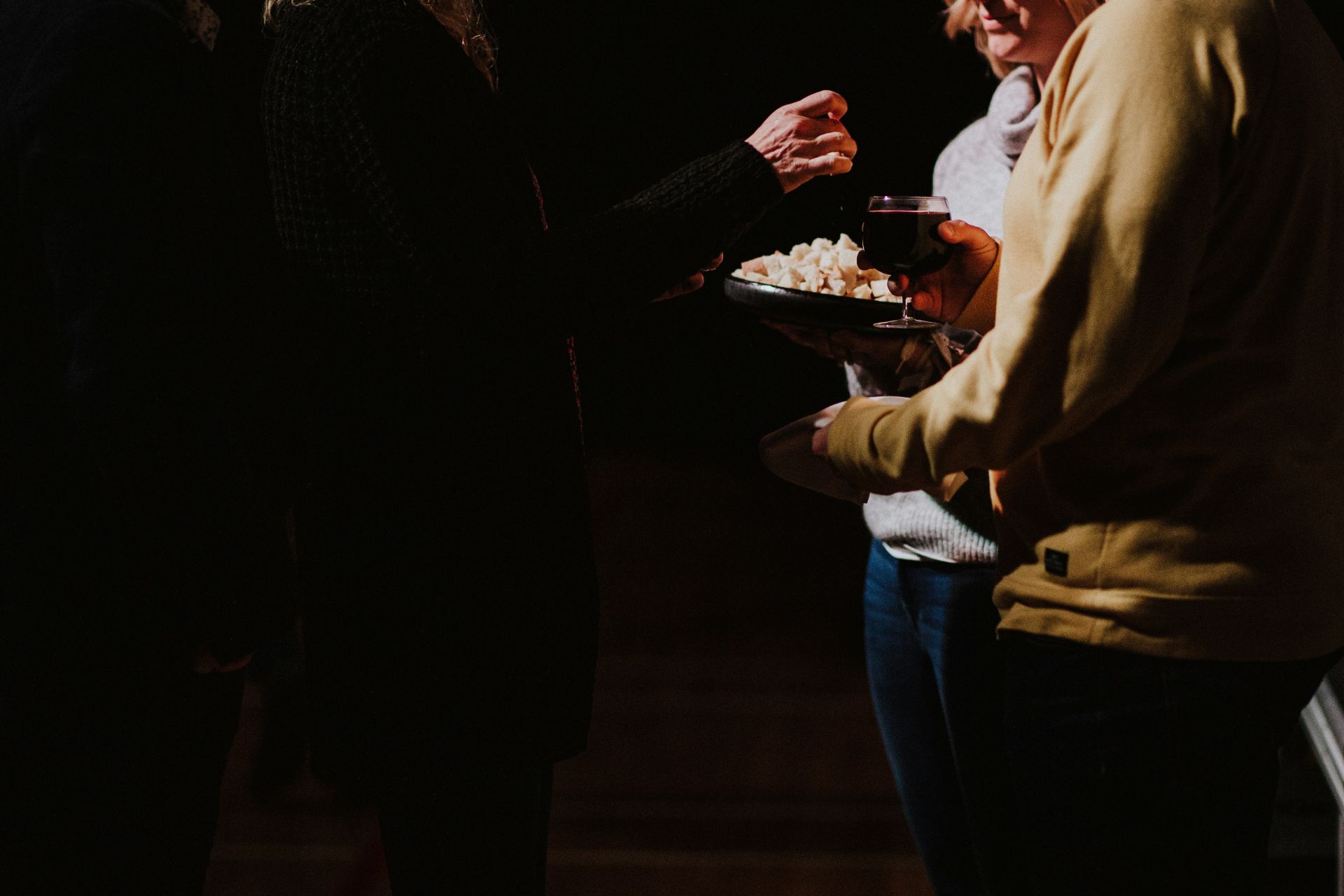
In the church, we are encouraged to read the Scriptures, learn the catechism, listen to sermons, and study theology. These are all important disciplines, but they are insufficient to form us as whole persons in the image of Christ. We must also be discipled emotionally through relationships and holistically through practices that engage our bodies. In my life, the embodied (and relational) practice of taking Communion at my church led to an emotional and physical breakthrough in my faith.
I was a seminary student at the time, deeply engrossed in theological study. I was also an adult survivor of sexual abuse, which I experienced around the same time my dad died of cancer. These twin traumas in my adolescence had formed me in ways I couldn’t articulate or even fully see—they pulled me, like invisible puppet strings, in directions I didn’t understand or desire. When I started receiving weekly Communion at a local church, these traumas began to surface. The physical act of holding out my hands and looking a priest in the eyes felt vulnerable, exposing the ache of having lost a parent. And receiving the body of Christ into my body made me grapple with physical shame I carried as an abuse survivor. Communion has so profoundly impacted my life and my ministry that I wrote a book about it (Feasting On Hope: How God Sets a Table in the Wilderness).
Healing, as we know, isn’t always top down. We can’t only talk or think our way into wholeness. Sometimes—and more than we may realize—healing is from the bottom up. This is one reason why somatic modalities like breath work, EMDR, and sensorimotor therapy have become so popular for treating trauma in the last decade. Considering this reality, it should not surprise us that Jesus instituted embodied, communal rituals for his followers: baptism and the eucharist. At the start of the Christian life, we are physically initiated into a community of believers, and as an ongoing expression of that Christian life we are physically fed at a table with other believers.
The sacraments are often taught as symbols that only “help” us as Christians insofar as we can think about what they mean. In other words, we have tried to disembody them. But what if these ancient rituals help us in a way that transcends our ability to think about them? What if they help us precisely by getting us out of our heads and into our hands, our taste buds, our eyes, and ears? This isn’t a suggestion that our thoughts don’t matter. It’s a recovery of our thoughts as belonging to a larger body—our own, and ultimately his own, the corporate body of Christ.
In your own faith journey, how have you experienced a severing between your thoughts and your body, or between your personal experience as a Christian and the larger body of Christ? In your ministry, how can you help disciple people in a way that is as robustly physical and interpersonal as it is intellectual?
Maybe your personality or your profession lends itself to one aspect of these more than the other. Mine does. But I am grateful that each of us belongs to a larger body of Christ, bringing different gifts and stories and experiences to the work of formation. Together we are learning what it means to be redeemed— body and soul.

Hannah Miller King
Hannah Miller King is a priest and writer in the Anglican tradition. She writes for Christianity Today and serves as associate rector at The Vine Anglican Church in western NC. Her book Feasting On Hope: How God Sets a Table in the Wilderness is available from InterVarsity Press on February 17.
Hannah Miller King is a priest and writer in the Anglican tradition. She writes for Christianity Today and serves as associate rector at The Vine Anglican Church in western NC. Her book Feasting On Hope: How God Sets a Table in the Wilderness is available from InterVarsity Press on February 17.
Copyright © 2026
Tax ID: 92-0930963
Mailing Address
1205 E Oak Knoll Ct
Newberg, OR 97132
1205 E Oak Knoll Ct
Newberg, OR 97132
Resources
-
Join Our Newsletter
-
Donate
Social